
Skip to content
Hair & GroomingAlbemarle

The studio held every peak. The app held every valley.

Eleven sessions and one finding. Clients were known in the room and treated as strangers on the screen.
11Sessions
1/5Delight on entry
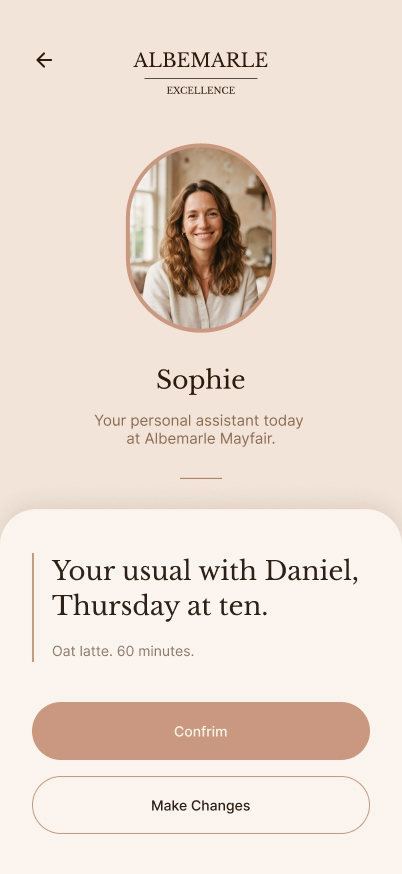
Albemarle home screen
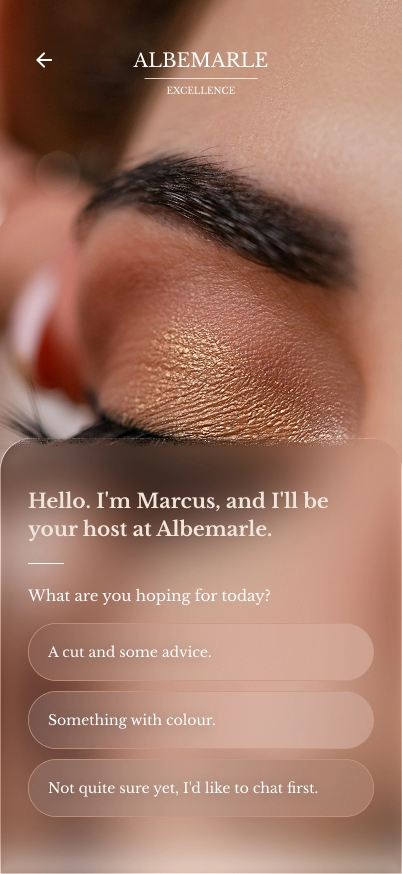
Albemarle host introduction screen
The brief

A house that knew everyone, and an app that knew no one.

Albemarle's hosts are exceptional. Across eleven studios in London, Manchester, Edinburgh and Bristol, clients are greeted by name and nothing needs explaining. None of that warmth reached the screen. The brief was to find where it stopped, why it stopped there, and what it would take for the app to behave like an extension of the host.

01
A client of eight years was asked whether she was new. She laughed and said, "It's like you've got a twin who's never met me." The gap had become a joke, and that was the problem.
02
Every emotional peak in the journey sat inside a studio. Every valley sat in the app, or in silence. Delight scored 1 out of 5, and every moment of it came from hosts working around the product.
03
Being known only felt like care when the client was in control of it. The same memory that makes a returning client feel expected feels like surveillance when the system decides how to use it.
The process

Eleven sessions. The same two Albemarles, every time.

The Anti-Principles and the Aspiration Gap, run separately, described the same break. A warm studio and a cold screen, belonging to one brand and often one afternoon. The Heartbreak Scale put numbers against it, with delight at 1 out of 5.

Core PrinciplesThe Heartbreak Scale™75 min
DiscoveryThe Aspiration Gap™60 min
DiscoveryThe First 60 Seconds™30 min
Brand PersonalityThe Dinner Party™15 min
Brand PersonalityThe Rejection Letter™30 min
Brand PersonalityThe Funeral Speech™20 min
Design PrinciplesDesign Principles Builder™60 min
Design PrinciplesThe Anti-Principles™40 min
Tone & CopyThe Voice Sort™40 min
"Luxury." "Curated." "World class." "Signature." "Bespoke." "Journey." The app's welcome copy used all six, and every one sat in the Voice Sort's wrong pile. The words that belonged were smaller: unhurried, at ease, known, considered.
Output 01: Strategy & Research

From a booking being processed to they already knew it was me.

Three documents carried the research. The Research and Insights Report recorded five findings and four root causes. The Aspiration Gap mapped where clients start and where they should end. Tone and Copy turned a voice that already lived in a host's text messages into rules a writer can follow.

Research & Insights Report
Discovery & Strategy

Research & Insights Report

Eleven sessions, five findings, four root causes. A record of what surfaced in the room, with nothing imported from outside it.

The app was added as administrative infrastructure, outside the rooms where Albemarle's character was shaped. The studio holds every peak. The app holds every valley.
Memory pointed at the business creates discomfort. Memory pointed at the client, used only to make something easier, creates trust.
The official voice describes Albemarle. The real voice describes the client. One talks about the service, the other talks to a person.
Download document →
The Aspiration Gap
Discovery & Strategy

The Aspiration Gap

Eight dimensions, from recognition to agency, mapped from where clients start to where they should end. Three critical moments carry almost all the weight.

The first recognition: a returning client sees their host's face and their usual appointment, one tap from done. The data already existed. Showing it was a design decision.
The experience ended on the pavement. The note that arrives that evening gives the afterglow somewhere to go, and starts the client's Albemarle story.
The third moment is the most fragile. Being remembered badly is worse than not being remembered at all.
Download document →
Tone & Copy
Brand

Tone & Copy

Six qualities held in tension, and six registers the voice never enters. Warm without being soft, honest without being blunt.

Use what you know. Never announce that you know it. "Thursday at ten, your usual time with Daniel?" is attentive. "We remember your preferences!" is surveillance dressed as care.
Every message carries a name. If it can't be attributed to a real person, it gets rewritten or it isn't sent.
One test for every line. Read it aloud. Does it sound like something a host would say, or something written to impress a stranger?
Download document →
Plus 6 more documents in the full engagement
04
Research & Strategy
The Feel Factor®
05
Research & Strategy
User Personas
06
Research & Strategy
Emotional Journey Maps
07
Design
Design Principles
08
Brand
Visual Direction
09
Brand
Copy Handbook
Output 02: The Design

Six screens, one recognised client.

From the first second a returning client opens the app, to the record they can read, edit and remove. Tap through the screens below.

Original
WAA
Output 03: Technology

A build order that protects recognition before features.

Thirty two weeks across four phases, sequenced by emotional dependency. The structure that lets the product know a client comes first. The features that depend on it come after. The handoff keeps the design intent intact once the build team starts solving local problems.
Implementation Roadmap
Delivery

Implementation Roadmap

Four phases across thirty two weeks: Emotional Foundation, Journey Architecture, Identity Layer, then Polish and Pre-Launch. The order is a design decision, not a project management preference.

Phase 1 builds recognition and the authorship logic before the post-visit note exists. The cross studio data pipes go in first, so the taps can follow.
The December Saturday scenario is tested in Phase 2, with real stylists and real schedules. The honest path, a holding message from the studio, has to be easier than the dishonest one.
Life moment recording waits for Phase 3. It carries the most emotional risk in the product, so it ships only after the trust built in Phases 1 and 2 makes it safe.
Download document →
Developer Handoff
Delivery

Developer Handoff

Not a functional specification. It holds the emotional intent behind decisions that might look arbitrary, the constraints that shouldn't be reopened, and the criteria the build is judged against.

The home screen opens on the client's named host and suggested appointment. A generic menu or a "Book now" button tells a client of eight years that she's still a stranger.
No message signed by a stylist or host goes out unless that person wrote or approved it. Otherwise it comes plainly from Albemarle. There's no third option.
Acceptance criteria are emotional as well as functional. QA checks whether a returning client describes the first screen as being expected rather than being processed.
Download document →
Plus 1 more document in the full engagement
03
Technical
Tech Stack Recommendations
The result

A product judged on whether a client feels known, not just whether the booking works.

Delight at 1 out of 5 and a client of eight years asked whether she was new pointed at the same root cause. The warmth lived in people, and the product had no way to hold it. The response was a set of rules specific enough to survive a busy Saturday, in the design and in the thirty two week build plan that protects it.

Recognition before request
A returning client opens on their host's name, face and usual appointment. A new client meets a person before a form. Account creation waits until booking confirmation.
A name means that person wrote it
A message signed by a stylist is written or approved by that stylist. Everything else comes plainly from Albemarle, and the honest holding message is built to be the easier path.
Their information, their choice
A "what we remember about you" view shows everything the product holds, in plain language. Every field can be edited or removed, and photographs stay private by default.
A build order that protects trust before speed
Recognition first, then travel, then depth, then polish. The roadmap makes that order a constraint, not a suggestion.
More work

Other case studies