
How to create an app.
Creating an app involves nine phases, from validating the idea to launching and growing a user base. Most take between three months and a year depending on complexity. Most cost more than founders expect and less than they fear, if the early decisions are made well. This guide covers every phase in order, with honest guidance on what each involves, what it costs, and where most projects go wrong. The section on planning, strategy and design is longer than the section on development and launch. That is deliberate.
Validate your idea.
Before spending anything, test whether the idea is worth building. Validation does not mean asking your friends what they think of the concept. People are kind. Friends will say it sounds great. None of that tells you whether real users would open the app a second time.
Real validation tests willingness to use. It sets up a situation where someone has to make a small commitment, sign up, click through, pay a deposit, fill out a form, and measures whether they actually do. The signal is in the action, not the opinion.
Start with competitor analysis. What already exists in this space? Where does it fail people? Read the one-star reviews of every product in the category. The gap your app needs to fill is usually sitting in plain sight there, written by frustrated users explaining exactly what they wish existed.
Define the core user problem in one sentence. One clear problem solved well is more fundable and more buildable than many problems solved poorly. If you cannot describe the problem without using the word "and", you are probably building two products at once.
Low-cost validation methods are everywhere. A landing page describing the product and capturing email addresses. A clickable prototype shared with a small group of target users. Twenty user interviews with the people whose problem you think you are solving. None of this needs to cost much, and all of it is cheaper than building something nobody wants.
The question every founder should be able to answer before proceeding is simple. Would real people use this over what already exists? If the answer is "probably" or "we think so", keep validating. If the answer is "yes, and here is the evidence", you are ready for the next phase.



Define your strategy.
This is the phase most guides skip past. We give it the depth it deserves, because every decision downstream depends on whether this one was made properly.
Product strategy covers four things. Who the audience actually is, beyond demographics. Where the product sits in the market and what it stands for. How you will measure whether it is working. And which features matter for version one versus everything else you plan to build eventually.
Most founders skip strategy for three reasons. Excitement about the idea. Pressure on the budget. Confidence that they already know what to build. All three are understandable. All three are expensive. A weak strategy does not announce itself early. It shows up six months later when the design team is guessing, the developers are building assumptions, and nobody can agree on what success looks like.
There is a real difference between knowing what you want to build and knowing what you should build. Founders almost always start with the first. Strategy gets you to the second.
MVP scoping happens here too. The job of version one is not to do everything. It is to prove one thing. If your hypothesis is "people will pay monthly for this", version one needs to test that and almost nothing else. The features that feel essential at the start are usually the ones cut first when reality arrives.
Strategy feeds directly into every subsequent phase. Without it, UX is guessing at what the user needs. Development is building on assumptions nobody has tested. And when a decision needs to be made about priorities, there is no reference point to make it against.

Strategy & planning is the phase that determines the quality of everything else.
Our planning engagement covers audience definition, MVP scoping, market positioning, and success criteria, so the rest of the build has a foundation to work from.


Research your users.
Real user research changes what gets built. Founders who skip it ship products designed for the founder, not the user. The two are almost never the same person.
User interviews are the foundation. Talk to fifteen to twenty people who genuinely fit the audience you defined in the strategy phase. Ask about the problem, not the solution. People are not very good at telling you what they want. They are excellent at describing what frustrates them, what they currently do instead, and what they wish was different. That is the material you need.
Competitor and market research sits alongside interviews. The job is to understand what users already tolerate and what they want instead. Tolerance is the opening. If users complain about something they put up with daily, that complaint is a product brief written by the market for free.
Personas come out of this work, not before it. Real personas are not demographic labels like "millennial professional". They are descriptions of specific people with specific problems, motivations, and contexts. "She opens this app at 11pm when she finally sits down and her brain will not stop" is a useful persona. "Female, 28 to 40, urban" is not.
Research findings change product decisions. The assumption that survives the brief almost never survives the first user interview. A founder assumes users will want detailed analytics on day one. Research shows users want clarity, not data. The feature gets cut. The product gets better. This pattern repeats across every project where research is taken seriously.
What happens when you skip research? You build for the founder. The product launches. A handful of friends sign up. Real users open it once and never come back. By the time you discover the gap between what you built and what users wanted, you have spent the build budget twice over.


Design the UX.
UX design is the structural thinking that happens before anyone draws a beautiful screen. It is the part most people see least and the part that decides most.
UX is not the same as UI. UX is about how the product is organised, how people move through it, and how easily they can do what they came to do. UI is the visual surface that sits on top. Confusing the two is the most common reason apps look polished and feel broken.
Information architecture comes first. It is the map of how the product is structured. What belongs together, what sits apart, what hierarchy users navigate through. Before any screen exists, the structure exists. Get this wrong and every screen designed on top of it inherits the problem.
User flows follow. A user flow is the sequence of steps someone takes to complete a task: signing up, finding a piece of content, making a purchase, checking their progress. Flows are designed before screens, because the path matters more than what the path looks like.
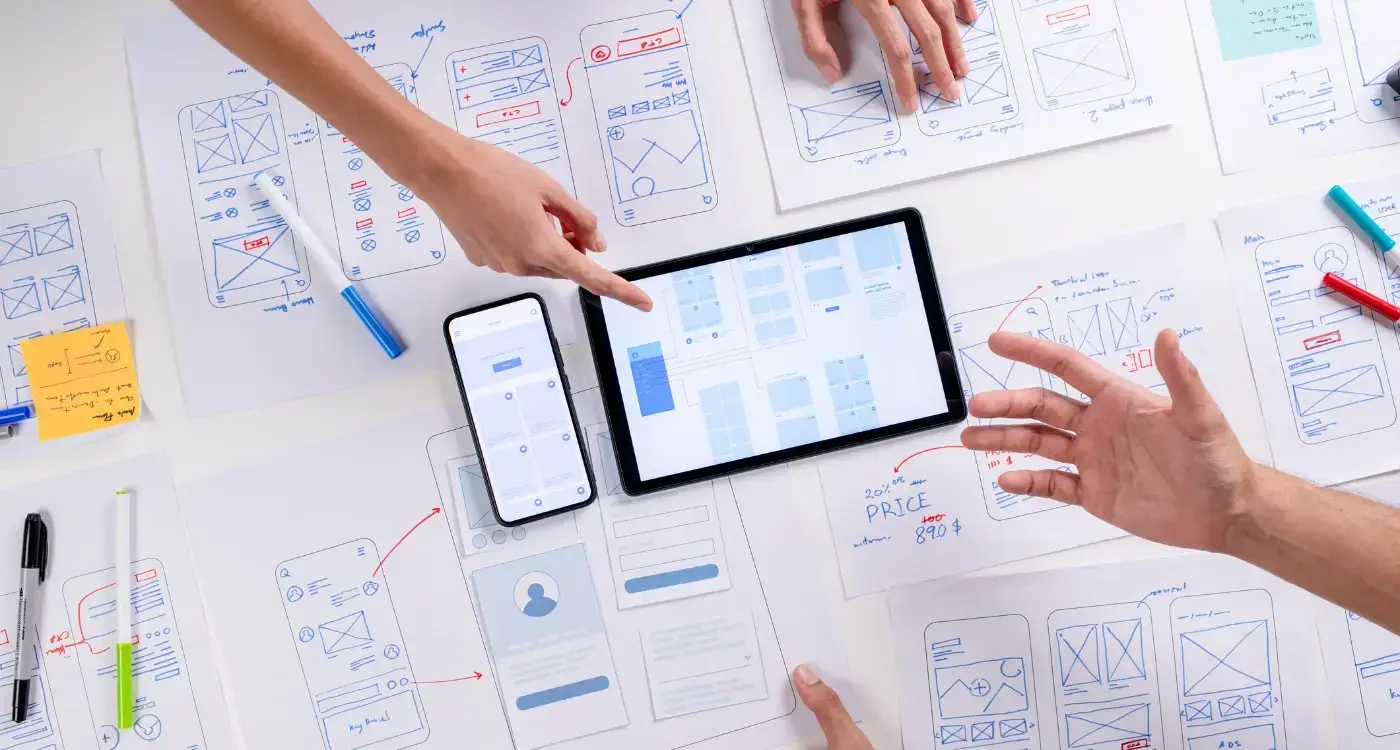
Wireframes come next. These are low-fidelity representations of screen structure, focused on what goes where and why. No colour. No final typography. No imagery. Just the bones. Wireframes are deliberately ugly so the conversation stays on logic rather than taste.
Prototyping turns wireframes into something testable. A clickable prototype lets real users move through the product as if it existed. You watch where they hesitate, where they tap the wrong thing, where they give up. That feedback shapes the next iteration. By the time UI design starts, the logic of the product has been validated by the people who will use it.
The cost difference between fixing a UX problem in design and fixing it in development is enormous. A flow change in Figma takes an hour. The same change in code, after the screens have been built and the backend connected, can take a week. Multiply by every issue that surfaces late, and the maths of skipping UX explains itself.
Our UX design service covers this phase from information architecture to tested prototypes.
Flows, wireframes, prototyping, and validation, done in the right order before a single visual screen is designed.



Design the UI.
UI design is the visual layer that sits on top of the UX foundation. It is what people mean when they say an app looks good. Done well, it makes the product feel inevitable. Done badly, it makes the product feel like a costume.
UI covers the visual language of the product. Colour, typography, spacing, imagery, iconography, the components that make up every screen, the motion that connects them. None of these are decoration. Each one carries information and tone.
The relationship between UX and UI is sequential. Structure first, surface second. A beautiful UI on a broken UX produces an app that looks great in screenshots and frustrates users by the second screen. A solid UX without proper UI feels generic and forgettable. You need both. In that order.
Design systems are where UI work pays back over time. A design system is the documented set of components, rules and patterns that the product is built from. Buttons, forms, navigation, error states, empty states. Everything defined once, reused everywhere. Without a system, every new screen is reinvented from scratch and the product slowly drifts out of consistency.
Good developer handoff is the other deliverable. The developer needs more than pretty pictures. They need the spacing, the states, the interaction logic, the responsive behaviour, the edge cases. A handoff that answers all of these questions before development starts removes weeks of back-and-forth later.
The difference between a screen-level design and a system is the difference between a draft and a product. Most freelance designers deliver screens. A proper UI phase delivers the system the screens come from, so the team can extend the product without breaking its design.
Our UI design service builds the visual language the product is built from.
Colour, typography, components, states, and developer handoff, the system, not just the screens.



Create the technical specification.
This step exists because design files are not a development brief. Most guides omit it entirely. That omission is the single biggest reason development projects come in late and over budget.
A technical specification covers what the designs cannot. Platform choices: native iOS, native Android, or cross-platform, and why. Data architecture: what the product stores, where, how it relates, how it scales. API requirements: what the app talks to and how. Security: authentication, encryption, what regulations apply. Performance: how the product needs to behave on a slow connection, a five-year-old phone, a flaky tube journey home.
Without a specification, getting development quotes is a guessing game. Three agencies will quote three different prices for three different products, because each one is reading between the lines of the brief differently. You cannot compare those quotes meaningfully. You are not buying the same thing.
There is a difference between a developer's internal architecture and a client-facing specification. The developer's notes are written for the developer. The specification is written for the client, so they understand what they are buying and can hold the build team to it. Both exist. The second one matters more before development starts.
This document de-risks the entire development phase. It turns "build us an app" into "build us this app, on this stack, in this order, to these standards, within this budget". The conversation with the development team changes from open-ended to defined. The money stops being theoretical and starts being scoped.
Not sure how to turn your designs into a development brief?
That is exactly what our architecture service produces, a client-facing specification the development team can quote and build against.



Find and brief your development team.
There are five common options for who actually writes the code. A freelancer. An offshore agency. A nearshore team. A UK agency. Or an in-house hire. Each carries different cost, different coordination overhead, and different risk.
Freelancers are the cheapest hourly rate and the highest single-point-of-failure risk. Offshore agencies offer real cost savings and real coordination cost. Time zones, language, cultural differences in how feedback is given. Nearshore (Eastern Europe for UK clients) trades some of the cost saving for closer working hours and shorter communication distance. UK agencies are the most expensive option per hour and usually the lowest friction. In-house hires only make sense for products that will keep needing development long after launch.
Evaluating a development team is mostly about how they answer hard questions. Ask them how they handle scope changes mid-project. Ask what happens when something takes longer than estimated. Ask to see code from a previous project and how it has aged. Ask who actually writes the code, not who you are speaking to in the sales meeting. The team that answers these questions clearly is rarely the cheapest.
A proper brief includes the strategy, the research findings, the UX work, the UI system, and the technical specification. Most founders brief development teams with a sentence and a Figma link. That brief produces a quote based on guesses. A proper brief produces a quote based on scope.
IP ownership matters. The contract needs to make clear that everything produced belongs to the client, not the developer. This sounds obvious. It is regularly missed. Read the IP clause before you sign anything, and if in doubt have a solicitor read it for you. The cost of clarity here is much lower than the cost of fixing it later.


Build, test, and iterate.
Development typically runs in sprints. Two-week cycles, each one ending with something demonstrable. Daily standups keep the team aligned. Regular reviews show the client what is being built, in small enough increments that course corrections are cheap.
Testing happens throughout, not at the end. Testing-at-the-end is how projects ship six weeks late with critical bugs nobody had time to find. Unit tests as code is written. Integration tests as features come together. Manual QA on every build. Continuous, not occasional.
Beta testing is where real users meet the product before full launch. A controlled group, instrumented properly, watched closely. What features get used. What features get ignored. Where people drop off. Where they ask for help. The pattern of real behaviour is almost always different from the pattern the team predicted, and the time to learn that is before the product is in the App Store, not after.
Development rarely goes exactly as planned. Something will take longer than estimated. A third-party API will change. A platform update will break an assumption. The question is not whether this happens but how the team handles it. A team that flags problems early and explains the trade-offs honestly is a team you can ship a product with. A team that tells you everything is fine until the day it isn't is a team you cannot trust.
The most common development problems trace back to poor briefs, not poor coding. Scope changes mid-build. Unclear requirements. Decisions deferred until they cannot be deferred any longer. The strategy, research, design, and specification phases you invested in earlier are what make this phase predictable. Skip them, and this is the phase where the price gets paid.


Launch and grow.
App Store Optimisation is the launch equivalent of SEO. Title, subtitle, description, screenshots, keywords. Each one has rules, character limits, and patterns that work. The store listing is the first interaction most users have with the product, and it does most of the work of convincing them to install.
A soft launch is the case for a staged rollout. Release the product in a single market first. Often a smaller English-speaking country, away from the eyes of the press and the App Store featuring team. Use the soft launch period to fix the issues only real-world usage surfaces. Then expand to the markets that matter.
Post-launch metrics worth tracking are the ones that show whether the product is working, not the ones that look good on a slide. Retention rate is the master metric. How many users come back the day after install. How many come back a week later. How many come back a month later. Session length tells you whether they are getting value when they do return. Day-7 and day-30 retention together describe whether you have a product people use, or a product people try once.
The product is not finished at launch. It is just beginning. Everything you learn in the first three months changes what version two looks like. Plan for that. Budget for it. The teams that win are the ones that treat launch as the start of the work, not the end.



How much does it cost to create an app?
The short, honest answer. The full picture lives in our cost guide. The single biggest factor in final cost is the quality of the decisions made before development begins.
| Phase | What it produces | Typical range |
|---|---|---|
| Validation | Evidence the idea is worth building | £0 – £5,000 |
| Strategy | Audience, positioning, MVP scope | £10,000 – £30,000 |
| Research | User interviews, personas, market view | £8,000 – £20,000 |
| UX design | Flows, wireframes, prototype | £15,000 – £40,000 |
| UI design | Visual system, screens, handoff | £15,000 – £40,000 |
| Technical specification | Architecture, stack, scoped brief | £8,000 – £20,000 |
| Development | The build itself, iOS & Android | £30,000 – £400,000+ |
| Launch & first iterations | ASO, soft launch, early fixes | £5,000 – £25,000 |
Ranges assume a competent agency, a real specification, and a defined scope. The variance within each row is mostly explained by complexity, integrations, and how cleanly the previous phase was completed.


Common mistakes to avoid.
Five mistakes that account for most of the project failures we see. None of them are obscure. All of them are common.
The ideas that feel most obvious to the founder are usually the ones most in need of testing. Obvious to you is not the same as wanted by users.
A half-finished design hands every unresolved question to the developer to solve in code. Decisions that should cost an hour in Figma cost weeks in production.
Without a specification, you cannot brief properly and you cannot compare quotes. You end up choosing on price and personality, both of which are the wrong criteria.
Every feature delays launch, increases cost, and dilutes the thing the product is supposed to prove. The MVP that ships beats the perfect product that doesn’t.
Launch is the start of the real work. Founders who plan a celebration and stop thinking about the product the day it ships are the ones who lose users in week two and never get them back.


Frequently asked questions.
How long does it take to create an app?
Honest ranges. Simple apps take three to six months. Mid-complexity products run six to twelve months. Complex products take twelve months and beyond. The biggest variable is the quality of the pre-development work. Strong strategy, research and design shorten the build. Weak ones lengthen it. Sometimes by months.
Do I need to know how to code?
No. What founders need to understand is product thinking, not technical syntax. Knowing how users behave, how to define the right problem, and how to make trade-offs between scope, time and money will help your project more than knowing a programming language. The developers will handle the code. Your job is to make sure they are building the right thing.
Should I build for iOS or Android first?
It depends on where your audience already is. The decision should come out of your research, not a default assumption. Cross-platform frameworks let you ship to both at once for many product types, which removes the question entirely. For a fuller view, read more in Android vs. iOS: which platform is right for your app development team?
What is an MVP and do I need one?
An MVP is the smallest version of the product that proves whether the idea works. Not a stripped-down version of the full vision, but a focused version designed to test the core hypothesis. Most founders benefit from building one first. For the distinction between an MVP and a prototype, read more in What’s the difference between MVP and prototype?
Three ways to start a conversation.
You can send us the details and we will come back to you. You can book a call and talk it through. Or you can look at the pricing first and decide from there. Whichever you choose, the next step is the same: defining what you are building, before you start building it.
Tell us about your project.
A short form covering the basics. We come back to you within two working days with whether we are a fit and what the right first step would be.
Send project details →Book a discovery call.
Thirty minutes with Simon. If we are the right team for the project, we will say so. If we are not, we will tell you who is.
Book a call →See the pricing.
Our service prices, in full. No "request a quote", no hidden ranges. Useful before any call, especially if budget clarity is what you need first.
See pricing →