
We do the work that makes an app worth building.
A UK app design agency focused on UX, UI, product strategy and technical architecture that makes the development process successful.
Choosing an app design agency is a decision about what happens before the build, not after it.
We Are Affective is a UK app design agency. We work with founders and product teams on the strategy, research, UX, and UI that happens before development begins. That is the entire focus of the studio.
Most agencies treat the design phase as a step on the way to something else. We treat it as the work that decides whether everything that follows is worth doing. Research the team can defend. User flows that hold up under real use. A visual system built to be handed off, not admired in a deck.
The question worth asking when you evaluate an agency is not just whether they can design well. It is whether what they design will actually work once the build starts and real users arrive. The rest of this page is about how we answer that question, and how to judge any agency you speak to on the same terms.

What does an app design agency actually do?
The phrase covers a wide range of work. Before you compare agencies, it helps to know what the scope can include and where one studio’s remit ends and another’s begins.
The core disciplines are reasonably consistent across the industry. UX research and user testing, to understand who you are designing for and what they actually need. Information architecture and user flows, which set the structure of the product. Wireframing and prototyping, where the structure becomes something a team can react to. UI design and design systems, where the product takes on its visual identity. And handoff to development, where everything is packaged so a build team can pick it up without losing the thinking behind it.
The variation between agencies is in how much of that scope they own and how deeply. Some start with discovery and strategy and treat research as load-bearing. Some skip discovery and begin at wireframes because that is what the brief paid for. Some hand off a Figma file and disappear. Others stay with the project through the build, answering questions and protecting the design as it meets engineering reality.
None of these models is wrong. They produce different outcomes. The studios that begin with research design products around evidence. The studios that begin at screens design products around assumptions. Both can produce work that looks accomplished. Only one consistently produces work that holds up once people start using it.


What to look for in an app design agency.
Four questions worth asking any studio you speak to, including us. They tend to separate agencies that do the work properly from agencies that do the work that fits the brief.
Do they start with research, or go straight to screens?
An agency that jumps straight to design without research is designing assumptions. Sometimes those assumptions are right. Often they are wrong in ways the team cannot see from the inside. Good agencies validate before they design, because the cost of fixing a wrong assumption in a Figma file is small. The cost of fixing it after development has shipped is not.
Do they understand mobile behaviour, not just mobile aesthetics?
App design is a behavioural discipline before it is a visual one. How users move through screens, where their attention drops off, what makes an action feel natural and what makes it feel like work, what builds a habit and what breaks one. These questions matter as much as the colour palette. An agency that talks only about visual quality is showing you the smaller half of the job.
Do they work with development teams, or hand off and disappear?
The design-to-development handoff is where many projects quietly lose their fidelity. Edge cases get reinterpreted. Animations get dropped because nobody flagged them as load-bearing. Copy gets rewritten by whoever was nearest. Ask how an agency handles handoff. Ask what they do when the build team has a question three months in. The answer tells you a lot.
Can they explain why, not just what?
A good design agency should be able to articulate every decision in the product. Why the onboarding has three steps and not five. Why this button sits here and not there. Why the language sounds the way it does. If the answer to “why did you design it this way” is “it looks good”, that is taste defending itself as strategy. Taste matters. It is not enough on its own.



Our process, in the order it actually happens.
Five stages. They run in sequence because each one informs the next, and skipping one tends to show up later in the product, not in the project plan.
Understanding the problem before designing the solution. Stakeholder sessions to surface what the team actually believes (which is rarely the same as what the brief says). Competitor and category analysis. A read of the technical constraints. And a product brief that everyone agrees with before a single screen is drawn.
Real users. Tested assumptions. Research that informs design, rather than design that is rationalised by research later. The aim is to know who you are designing for, what they actually do, and where the product needs to meet them. The output is a set of evidence-based decisions the team can defend, not opinions.
Information architecture, user flows, wireframes, and interactive prototypes. Every screen has a purpose. Every interaction has a reason. This is the stage where the structure of the product is decided, and where the team can change direction cheaply if anything is off. The prototypes get tested. The flows get refined.
Visual design, component libraries, and a design system built to be handed off. The product takes on its visual identity here, but the work is structural as much as aesthetic. Components that scale. States that are documented. A system a development team can pick up without having to interpret what was intended.
Technical architecture is part of the scope, not a bolt-on. Development teams receive the design files and a clear specification of what to build, including the reasoning behind the trade-offs. They are not handed a Figma file and asked to interpret it. They are handed a brief that has already been thought through.

Ready to talk about your app?
If the process makes sense for what you're building, the next step is a short conversation. No deck, no pressure.
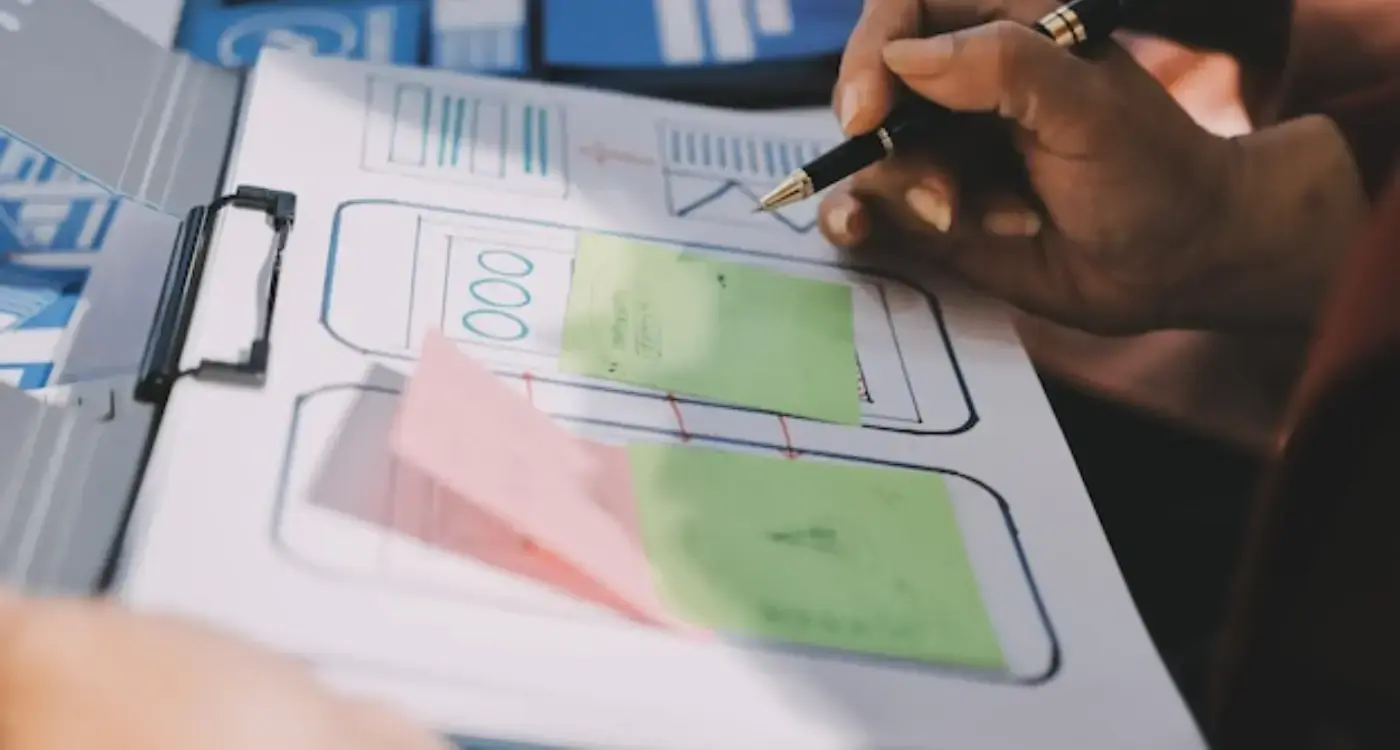


What good app design actually involves.
Six parts of the work that clients rarely know to ask about. None of them are visible in a Figma preview. All of them decide whether the product feels right once it is in someone’s hand.
Cognitive load
Every screen asks the user to think. Good design reduces what they have to think about so the action they came for is the only one in front of them. Bad design adds choices and calls it flexibility.
Micro-interactions
The small responses. A button that confirms. A list that re-orders smoothly. A loading state that explains itself. None of these are decorative. They are the moments that tell the user the product is working.
Emotional design
How the product feels to use, deliberately rather than by accident. Trust is built (or eroded) by tone, pace, and the language a product uses for the small moments most teams never write.
Typography at small sizes
Readability on a phone is not a desktop type system shrunk down. The choices about size, weight, line height, and contrast carry more weight on a small screen than on any other surface.
Accessibility
Designing for the full range of users who will arrive, including the ones with low vision, motor difficulties, or screen readers. Done well, this work raises the quality for everyone, not only the people it was strictly aimed at.
Design system thinking
One-off screens scale badly. A design system is the difference between a product the build team can extend without breaking, and a product where every new feature reopens decisions that should already be settled.



Four types of team we tend to do our best work with.
Different starting points. The same need underneath: the foundation has to be right before the build begins, or be put right before it goes any further.
Founders building their first app
The product idea is real. The brief is taking shape. The team wants the foundation to be right before committing the budget that development asks for. This is the engagement that pays for itself most clearly.
Product owners at scale-ups
An existing app that has outgrown its original design. The patches have worked, up to a point. What is needed now is proper UX architecture rather than another reskin that papers over the structural issues.
Innovation teams at enterprise organisations
A new product line, an internal tool, or a customer-facing app that needs design done at a level the in-house team isn’t set up for. The brief is usually well-defined. The job is to do it properly.
Founders who’ve already tried development
The app exists. Users aren’t behaving the way the team expected. Sometimes the answer is a design retrospective. Sometimes it is a rebuild. The first job is to find out which, honestly.
Does this sound like you?
Tell us about your project and we'll come back with what we think the right first step is.

App design across industries.
Our work spans industries with distinct user expectations and regulatory contexts. Good app design adapts to the audience, not the other way round.






Frequently asked questions.
How much does it cost to work with an app design agency?
It depends on scope, complexity, and how much research the project actually needs. A Foundation engagement (strategy, research, UX, UI, and handoff) is the most common starting point and sits in a defined band. For a full breakdown of what drives the cost and where the variation comes from, read more in How Much Does It Cost to Build an App?
Do I need a design agency if I already have a development team?
Yes, in most cases. Development teams build what they are briefed. Their job is to make the brief work, not to question whether the brief is right. A design agency is the team that creates the brief in the first place. Without that work being done properly, even a strong development team will end up building the wrong product correctly.
What is the difference between UX and UI design?
UX is the structure: how the product works, how users move through it, what each screen is for. UI is the surface: how the product looks, the visual system, the typography, the colour. UX without UI is a wireframe. UI without UX is decoration. Good app design treats them as two halves of the same job, not separate phases. Read more in Why Beautiful Apps Fail: The UX Lessons Every Founder Needs.
How long does app design take?
A focused Foundation engagement typically runs two to six weeks. A larger product with deeper research, more flows, and a wider scope can run twelve to sixteen weeks. The honest answer is that timeline scales with how complex the product is and how much is already known about the user. We can give you a defensible estimate after a short discovery call, rather than a number that has to flex later.
Start here.
Three routes, depending on where you are. Send the brief, talk it through first, or get a clear picture of cost before you do either.
Send us the project brief.
The fastest route. Tell us what you’re building, the rough scope, and the timeline. We’ll come back with an honest read on whether and how we can help.
Send project details →Book a discovery call.
Thirty minutes. We’ll talk through the project, the questions you still have, and what a sensible first step looks like. No deck, no pitch.
Book a call →See what it costs.
A clear breakdown of how we price our engagements and what drives the variation. Read it before you talk to us, so the conversation starts from the right place.
See pricing →